Monday, September 16, 2013

Recipe: Slow Cooker Pulled Pork

I have fallen in love with my slow cooker. It was a gift from a co-worker for my wedding shower, and I've probably used it a handful of times over the last 8 years. Then, a few months ago I chose a Slow Cooker cookbook as my cookbook of the month and had to dust it off.

And I fell in love.

I'll admit, I'm one of those people who always wondered why I would spend 4 hours cooking a soup I could make in a pot on the stove in 30 minutes. Turns out I was missing the point. The slow cooker allows flavours to meld together. I frees up space on the stove top or in the oven for other items, which is important for me since I cook for the week all at once. It makes meat fall off the bone like butter. And it is a one pot wonder, with a removable inner bowl that allows me to cook and store the meal in the same container.

What more could I ask for from an appliance?

Not much.

Which is why it now has a permanent spot on my already cluttered counter.

I put it to good use this weekend cooking pulled pork. Actually, I bought a huge 4kg pork shoulder (bone in), cut it in half, and made one with a pulled pork sauce, and the other with a BBQ sauce. Absolutely divine, and so easy. The recipe below is for one recipe, which serves 6-8. If you want to do what I did, I recommend cooking it in two batches as well for even cooking, even if you're using the same sauce for all of it.

Slow Cooker Pulled Pork

Ingredients

1 pork roast (about 2kg or approx. 4lbs.) or 1/2 pork shoulder of same weight
1 jar your favourite gluten free pulled pork sauce (approx. 500ml)
If you don't have a favourite, why not try my GF Strawberry BBQ Sauce Recipe?

Directions

1- Trim the pork of any large chunks of fat. If it is tied up, untie it. Place it in the slow cooker. Cover pork with sauce and add 1/4 cup of water to thin sauce a bit to start. Turn on slow cooker to cook for 6 or 8 hours. If you are cooking this overnight and won't have your eye on it occasionally, I would choose 8.

2-  If cooking at a higher heat, check on meat every hour and baste with sauce.  When cooked, remove meat and allow to sit a few minutes until it's cool enough to handle. Flake the pork with a fork and place in serving dish. In the meantime, pour sauce into a saucepan and simmer until it reduces to about 1/2 the amount. Pour over pulled pork and serve.


My Strawberry BBQ Sauce


Sunday, September 15, 2013

Gluten Free Weekly Menu Plan


Monday: Gluten Free Meat Lasagna (Recipe) 


Tuesday: Steamed Salmon with Carrots & Greens  (Place salmon & carrots in steamer on different levels & cook until done. Toss salad.)


Wednesday: Stuffed Poblano Peppers (Recipe) with Chili-Lime Feta Corn on the Cob


Thursday: Butternut Squash & Apple Soup


Friday: Cabbage Rolls 

Saturday, September 14, 2013

Toronto Gluten Free Expo 2013

This morning I piled the family in the car and we drove downtown to the Gluten Free Expo. I went last year for the first time, when it was held in a hotel in Mississauga, and was so popular that they were filled to capacity and people had to line up outside in the lobby to wait for a chance to get in. This year they held it at the Metro Toronto Convention Centre, a HUGE location, and sold advance tickets which allowed holders to enter two hours before the general public. Even with advance tickets it was pretty busy in there. I can't imagine how crazy it got after it opened to the general public! By the way, kids got free admission.


One small part of the Exhibit Hall minutes after the doors opened.
 
Some people ask me why I bother to go to these events year after year. I go for a few reasons. The first is my son. There aren't many places he can go where he can eat EVERYTHING without worry. For one day, if the kid wants to stuff his face with as many free samples as he can handle, so what? There are enough days when he goes somewhere and there's NOTHING he can safely consume. What I liked about this year's Expo was that at every booth serving food there was a card that the vendor filled in showing which allergens were present. Helpful for those with more than just a gluten restriction.


The second reason I go is to support businesses who are doing gluten free right. Those which are certified gluten free, local business that offer a small range of products and rely on expos such as this to get their product noticed. That doesn't mean I like every vendor or every product, but I appreciate that there are more choices available for my son today than there have ever been before. As a consumer, I get to choose which of those products I want to purchase, but an Expo is a great place to sample and learn about products with no need to purchase if it's not right for me.

The third reason I go is to meet people and learn about what's new. Particularly with smaller bakeries who have booths staffed by the actual people who run the business, it's a wonderful way for me to make personal connections and chat about their product. It's also a great way for me to get an idea of what's new and what trends might be on the way. For example, this year I noticed many more organic, vegan, and paleo offerings than I have in the past. There were also more companies offering different ethnic foods, like the all-natural Indian spice mixes I picked up.


What we brought home from the Expo

It's also fun! I chatted up other visitors, tried some great products, and picked up business cards and pamphlets. This year's Expo had wider aisles, a larger venue, a cafĂ©, and a stage for presentations. It felt like it flowed better than last year's did, and it was good value for the money. Definitely going to be a yearly tradition for my family.

The Expo is open on Sunday as well. If you're thinking of going, more info can be found at their website www.glutenfreeexpo.ca

Friday, September 13, 2013

Happy Celiac Awareness Day 2013!

There's always a lot of talk about gluten free, but sometimes Celiac Disease is lost in the fray. It's important to remember that Celiac is a serious autoimmune disease that can have devastating health consequences for those who go undiagnosed and untreated. In addition, a failure to follow a strict gluten free diet is absolutely necessary to stay healthy. While there is more awareness of the disease today than there was fifty years ago, it is still woefully undiagnosed. On average, it takes between 6-10 years before a person is diagnosed. That's years of suffering, of visiting doctor after doctor, of being subjected to a variety of tests. We need to help raise awareness to help improve those statistics.

The problem is that the symptoms of Celiac are so varied that they are often mistaken for other illnesses. Other times they're brushed off as an upset stomach, a common parasite, or even being "all in your  head." For silent Celiacs, there are not outward symptoms at all, although the damage is still occurring on the inside. The National Foundation for Celiac Awareness has a handy symptom checklist that is useful in identifying symptoms that could indicate Celiac Disease. The sheet can be filled in online, then printed out and taken to your doctor for follow-up. Access the form by clicking HERE.

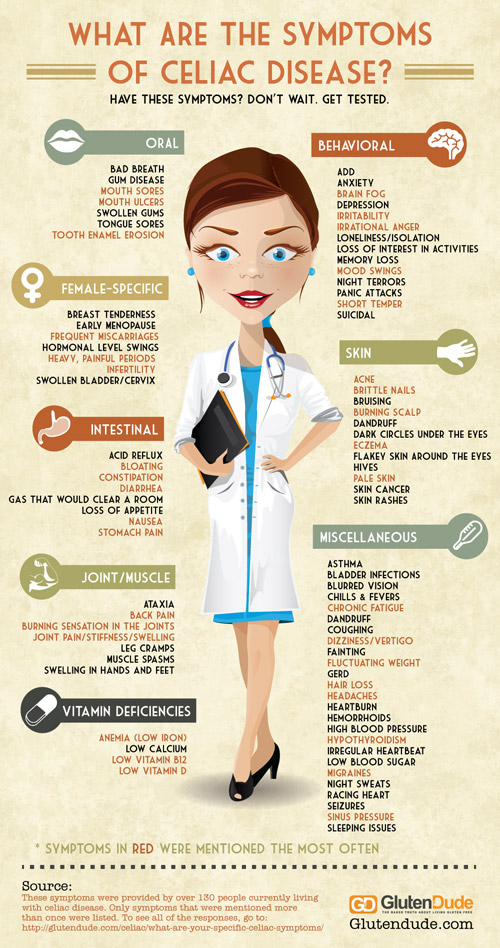
A fellow blogger, Gluten Dude, created this handy infographic outlining some of the symptoms associated with Celiac. Does that clear things up? No? That's because the symptoms of Celiac are so varied that what one person experiences as symptoms can be completely different from what someone else does. This makes diagnoses even more complicated.


Celiac Disease Symptoms
Celiac Disease Symptoms – Courtesy of Gluten Dude


Some Facts About Celiac:

- Past estimates put the rate of Celiac in the United States and Canada at 1 in 133. More recent estimates put it at 1 in 100.

- Celiac disease used to be considered a childhood illness, but it actually affects people of all ages. While a gluten intolerance or wheat allergy may be outgrown, Celiac disease is a lifelong illness that cannot be outgrown.

- Even tiny amounts of gluten can make someone with Celiac Disease sick.

- There are no vaccines or antibiotics for Celiac Disease. The only treatment is the adherence to a strict gluten free diet.

- It is estimated that roughly 80% of those with Celiac Disease are undiagnosed.

Awareness is key to help get those who may not know they have Celiac Disease diagnosed, so they can begin to eat a gluten free diet and be medically monitored. Celiac Disease is linked to many other conditions, including Type 1 Diabetes, Downs Syndrome, and Thyroid Disease, just to name a few. Many Celiac patients have anemia, low levels of Vitamin D, and are at risk of contracting many kinds of Cancer, infertility issues, and more. With the rise of the trend in gluten free, it is often forgotten that Celiac is a serious disease with terrifying health consequences.

Take the time today to educate someone on this disease, and to encourage someone exhibiting some of the symptoms to talk to their doctor.

Ribbon from Prevention.com


Thursday, September 12, 2013

Naturally Sweet & Gluten Free Desserts: Interview with Ricki Heller


Ricki Heller's new cookbook, Naturally Gluten Free Desserts is being released this month, and she graciously agreed to answer a few questions from me. Her answers are thoughtful and interesting and give some great insight into what to expect from the new book!


1- Your new cookbook features delicious desserts that are vegan, and for the most part, free from many of the top allergens. Why was it important to you to create recipes that are free from so many commonly used ingredients?


Most importantly, Naturally Sweet and Gluten-Free is my response to so many of my former customers when I ran an organic bakery, as well as to current readers of my blog. The number of people with food allergies or dietary restrictions continues to grow every day. I know there are a lot of people out there who have a hard time finding all kinds of foods they can eat, including tasty desserts. For me, there’s nothing quite as gratifying as hearing from someone who tells me they used my recipe for their child’s birthday cake, or served my brownies at a pot luck, and everyone loved them and was able to enjoy them without worrying about allergies.

In addition, the recipes simply reflect the way I now eat, so you could say they come naturally to me. My diet is a variation of the anti-candida diet (for people with yeast overgrowth in the body), and it requires foods low on the glycemic index so blood sugars remain stable. It’s also a low allergen diet, since part of the purpose is to reduce the toxic load in the body so it can focus on healing itself. I’ve been eating a vegan diet for many years, adding gluten-free and sugar-free within the last ten years or so.

2- What types of desserts are featured in your new cookbook? What can a reader who is not familiar with your past work expect from this new cookbook?

The book contains every kind of baked good and sweet treat you can imagine, with variations on most of the classics. So there are chocolate chip cookies, brownies (five different kinds, actually!), cinnamon buns, pecan pie, cheesecake, muffins, pancakes, scones, ice creams, puddings. . . basically, any kind of dessert or breakfast baked good, revamped so that they are free of eggs, dairy, gluten, corn, yeast or high glycemic sweeteners. And everything is made from whole foods, unprocessed ingredients and natural sweeteners—nothing artificial in anything!

In addition, some of the recipes include atypical ingredients (such as veggies hidden in sweet treats), or grain-free sweets, such as the coconut flour biscuits or raw brownies, which will appeal to people on lower carb diets.  While some of the ingredients, such as coconut sugar or millet flour, may not be familiar to some readers, they can all be found at health food stores and online, or easily substituted with more conventional ingredients (such as all-purpose gluten-free flour or more common sweeteners instead of coconut sugar and coconut nectar).  There’s an entire chapter on ingredients and substitutions; and the recipes themselves contain clear step-by-step instructions with lots of helpful hints and tips to guide you as you go along, even if you’re a novice baker.

3- Which recipe from the new cookbook is your personal favourite? Why?

Oh, that’s such a tough question, because my most recent recipe creation is always my favorite! I’m going to fudge the question a bit and give you my three top picks if that’s okay.
 
I’m a chocoholic, so I will start with a brownie! I love all five brownie recipes in the book, but my go-to would have to be the Sweet Potato Brownies. They’re fudgy, dark, dense and just all-around great—a perfect treat to serve any friends who might be skeptical about “special” diets!  And if you like, top them with the Allergy-Friendly Chocolate Buttercream Frosting, made without grains, dairy, eggs, sugar, nuts, corn or soy, another favorite. I’m also a huge fan of breakfast and brunch, so I’ve made the Carob-Buckwheat Pancakes with Chopped Almonds and Carob (or Chocolate) Chips countless times. Finally, I just love the Butter Tarts (a Canadian classic, normally made with butter, sugar, eggs, brown sugar and corn syrup, sort of like pecan pie without the pecans). Have you ever heard or a rich, gooey, decadent butter tart without gluten, eggs, butter or sugar? Well, that is one to try! My hubby tells me they taste just like “the real thing,” too.
Hmmm. . . I guess that’s actually four recipes! Sorry about that. ;-)


4- You are a long-time advocate of the vegan diet. What advice would you give someone thinking of going vegan?
 
Just remember that there’s such a thing as vegan junk food, too—and be careful what type of food you eat! When I first started eating a vegan diet in my 20s, I had no idea about nutrition or the need for sufficient protein in my diet, and I believe that’s part of the reason I got sick.  Focus on whole, real foods, and you should do just fine.  And it’s a good idea to read a couple of books on the subject, such as Becoming Vegan by Brenda Davis and Vesanto Melina, or Vegan for Her by Virginia Messina and JL Fields, to help you navigate all the different nutrients and ensure that you’re eating a healthy diet. It’s not difficult, but it does require some knowledge.

5- You eliminated gluten from your diet several years ago. Can you explain why you made that decision and how it has improved your overall health?

I was required to give up gluten during the first stage of the anti-candida diet, as a way to minimize potential allergens in the body.  Although I never thought I had a problem with gluten, as soon as I removed it from my foods, I began to feel better. Symptoms such as bloating, stomach pain and irritable bowel syndrome seemed to resolve themselves naturally. On the few occasions, in the beginning, when I did eat gluten again, the symptoms immediately returned, sometimes within minutes. I decided I’d continue eating gluten-free because it seemed to be the best option for me.
I also much prefer baking with gluten-free flours compared to wheat flour. Look at all the varied options you have with gluten-free flours! The possibility for different tastes and textures are endless. With wheat flour, it’s basically the same outcome, all the time. How boring is that?
 
6- Often, substituting ingredients can be expensive. What advice can you give to those cooking or baking with food restrictions, but who need to stick to a budget?

There really are ways to keep the costs low. I always buy in bulk if I can, and freeze my nuts or seeds so they will last (I also freeze any flours that I won’t use within a few weeks, since gluten-free flours are mostly whole-grain, which means they contain volatile oils that can become rancid if left too long at room temperature). I make my own all-purpose gluten-free flour mix (the recipe is also in the book) instead of buying the packaged all-purpose gluten-free flour, which can be very expensive. And it’s surprisingly easy to make your own flours from whole grains, too, as long as you have a coffee grinder or spice grinder!

I find that if you stick to real, whole foods, your costs are inevitably lower. In other words, an apple is cheaper than applesauce; whole millet is cheaper than millet flour. And since so many products contain additives or potentially suspect ingredients anyway, it really does make more sense to create as much as you can from scratch.


Using only whole foods ingredients, a generous pinch of humor and input from her two chatty canines, Ricki shares gluten-free, allergy-friendly and sugar-free recipes on her blog, RickiHeller.com. Ricki’s second cookbook, Naturally Sweet & Gluten Free, will be released in September, 2013. Her first book, Sweet Freedom, is one of only three cookbooks recommended by Ellen DeGeneres on her website. Ricki is also an Associate Editor for Simply Gluten-Free Magazine and has written for Clean Eating magazine, Allergic Living, Living Without, VegNews, and many other publications. Ricki lives near Toronto, Canada with her husband and two dogs.


Tuesday, September 10, 2013

Family Approved Gluten Free Cookbook Winner Has Been Chosen!

I'm excited to announce that a winner has been chosen for the Family Approved Gluten Free Cookbook! This giveaway was a quick one, with only a week to answer, but the response was still incredible. Thank you to everyone who took the time to enter. If you didn't win this time, no worries because I have another great giveaway in store for September's cookbook of the month. The post announcing September's cookbook went up this morning, and the giveaway will be posted later this month, so keep checking back!

The winner of the August cookbook of the month is Simran S. Check your email!

September's Cookbook: Naturally Sweet & Gluten Free by Ricki Heller

Naturally Sweet & Gluten-Free
Allergy-Friendly Vegan Desserts

Naturally Sweet & Gluten-Free will prove that you can have your cake and great health too! The desserts and other baked goods found in this book were inspired by the author’s decision, after decades of baking and indulging in unhealthy sweets, to radically heed her body’s wake-up call and radically alter her diet.
The book features:
- 100 dessert recipes all free of gluten, eggs, and dairy; many are also soy-free (or offer a soy-free option), corn-free (all but one!), and nut-free (or offer a nut-free option)
- Comprehensive introductory matter, including helpful information on: ingredients, tips & techniques, tools & bake ware, and an at-a glance pantry list
- The author’s first book, Sweet Freedom, is listed on Ellen
DeGeneres’s Web site as one of her top vegan cookbook picks

This is the first time I've chosen a dessert book for the cookbook of the month, but this one just looked too good to be true. I make no secret about the fact that this blog exists specifically because my son needs to be gluten free, and that's what I focus on, but he also has issues with dairy. I also know that many people who are gluten free also have other food restrictions to deal with, and this book offers desserts free from gluten, dairy, eggs, or refined sugar, which I think may be of interest to many of you who read the blog.

This book is being released this month, and I'm excited to announce that not only do I have an interview planned with the author, I will also have a physical copy of the book to give away to one of you! If you're interested in hearing Ricki Heller speak, she will be at the Toronto Gluten Free Expo this weekend.


Monday, September 9, 2013

Recipe: Gluten Free Eggplant Cannelloni

Traditional cannelloni is made with pasta noodles, but I wanted to put a lighter spin on things and omit the pasta altogether for a naturally gluten free dish. I've mentioned before that my  husband took some convincing before he came around to enjoying eggplant, but now he's a convert! These are so easy to make, yet they look complicated and fancy. One large eggplant made 10 rolls, which is enough for my family. The recipe could easily be doubled or more. I use homemade tomato sauce, but if you're buying from a jar, one jar should be enough. Or, buy a jar of strained tomatoes, add some garlic, basil, olive oil and salt to the tomatoes in a sauce pot, and simmer until flavours are combined. A little bit of tomato paste can thicken things up.


Eggplant Cannelloni

Ingredients

1 jar tomato sauce, put aside

1 large eggplant
1 container (475g) ricotta cheese
1/2 cup good quality grated Parmesan cheese
1 bunch baby spinach, washed and stems trimmed, roughly chopped (or 1 box frozen spinach, thawed and well drained)
2 cloves garlic, minced
1/2 tsp. nutmeg
Salt & Pepper to taste

Directions
Preheat oven to 350F


1- Thinly slice clean eggplant lengthwise (to get long strips, not rounds) and place on baking sheet. Sprinkle with salt and let stand 10 minutes. This draws out the bitter taste. Wipe off salt with a paper towel. Place eggplant in preheated oven and bake for 10 minutes. Remove and set aside.

2- While eggplants are baking, heat tomato sauce to a simmer.  In a frying pan, sautĂ© spinach and garlic until spinach is wilted. Turn off heat. If there is any liquid in the pan, drain it.

3- Add ricotta, Parmesan, nutmeg, salt and pepper to spinach. Stir to combine.

4- Place about 2 tablespoons of spinach and ricotta mixture on a slice of eggplant, about a quarter of the way down from the top. Roll eggplant around mixture, and secure with a toothpick. Place in a baking dish. Repeat with remaining slices. When finished, ladle tomato sauce over eggplant rolls. Top with more grated parmesan, if desired.

5- Bake for 10 minutes, or until heated through. Serve immediately or place in fridge, covered, for up to 3 days.

Sunday, September 8, 2013

Gluten Free Weekly Menu Plan


Monday: Vegetarian Eggplant Cannelloni 


Tuesday: Stir Fried Pork & Vegetables


Wednesday: Turkey Breast Roast & Roast Vegetables


Thursday: Roast Chicken & Vegetable Soup


Friday: Roasted Vegetable Wraps w/Goat Cheese & Sundried Tomato Pesto in GF Corn Tortillas